There is so much divide and rule policy going on in the name of religion, about whom to worship. Yet, despite all that, betraying all the gods in the world, how have we conveniently ended up worshipping politicians? Are we precipitating political corruption? Time to ring the alarm bells?
Isn’t the political leader today the same guy who did not know how to respond to the tragedy of a pandemic? The same guy who thought what he did was sufficient, the best he could. Instead of asking him to be accountable for his actions towards the dying millions, we decided to praise him unconditionally for the growing mess. Every leader from every country has failed. No matter how small or big their failure is. Are we waiting for akashvani (message from the sky) to realize this?
Why do we end up worshipping politicians? Is it their larger-than-life presence, like our omnipresent gods? Or is it, our idea of God is so small and limited that anybody can be a god now? A celebrity, a politician, a religious person – anyone who hovers above us and seems larger than life through television, social media, or podiums, is a god now.
Wasn’t the concept of elections meant as a deal where we are supposed to end up gaining something? Like, we vote and they increase employment. Maybe it will work when we expect our leader to be more humane than godly. Then we will not only set the correct but also deliverable expectations. Why not accept them for who they are? Then their whole life will be spent delivering results instead of maintaining a worshipable image.
Let us use our minds instead of hearts to vote. Then the leaders will also focus on work and not just emotional speeches. They need to understand humiliating opponents is not the measure of a leader, growth and development are. And we need to understand we cannot idolize a person to end up whitewashing his mistakes.
It is time to be more responsible in selecting leaders. Time to vote for a good job on regulation, maintaining peace and order, and prevailing fundamental human not religious rights. Time to criticize and ask for change if needed. Let us appreciate their right decisions and powerful speeches, and not blindly agree with everything they do. But isn’t all this a natural progression if we just utilize our God-given minds.
Did you know worshiping celebrities is a syndrome now? In fact, ‘celebrity worship syndrome‘ is an obsessive addictive disorder, which in simpler terms means that an unknown stranger is controlling our minds. When put in the exact words, it is creepy, no?
I don’t understand how people can be fans. Fans of celebrities, religious speakers, industrialists, rich people, politicians. Celebrities? Their lives are tailor-made images painstakingly stitched by influential PR agencies. Politicians? How can someone be a fan of a politician, when their whole life is a web of lies. Their expertise is a stratagem. Let’s be fair, strategy is never about justice, it is about how to get what you want. And rich people, what are you a fan of? Money? Their money? It is not even yours. You are just a fan of how much they spend, what is the price of their costliest pair of shoes? I mean, in what frame of mind does this all make sense?
We have built a society where an entertainer gets billions, and farmers not even hundreds. A society where a politician is expected to do nothing, while the common man toils for hours to get a one-time meal. How did we end up with this topsy-turvy society of worshiping celebrities?
How did we end up in a society where fashion is more important than food? Where food is not consumed as per the needs of our body, but instead as per the fad.
Yes, Economics can surely explain the demand and supply of celebrities, but can Logic explain it? Everything is upside down. Don’t get me wrong, I am not against you liking people or learning from them. But what can make you follow someone? Does it even make sense, that our top priority is entertainment instead of basic necessities and survival needs?
Am I the only person who thinks water is flowing from the bottom to the top in this world of ours? Can we undo all this by taking one step at a time? For today, let us just appreciate and not follow. Our few small steps, will let the water flow from top to bottom, after all it is the natural way of things, no?
Editor’s note: This piece is intentionally direct. It questions collective responsibility and challenges the habit of outsourcing accountability to “the system.” The tone reflects the urgency of the question it raises. I’m keeping it here as part of a larger inquiry into responsibility — personal, social, and psychological.
During the pandemic, we kept on blaming the system for our hardships. However, is it right for us to blame the government when we voted for them irresponsibly? We expect a lot from our politicians, and the least of it all is taking the blame when things do not work. In all honesty, is our responsibility shifting appropriate? Indeed the government has to build a strong infrastructure, serve the citizens, blah blah blah. To start with, who elected the government? We deny acting on our responsibility, yet we are ever-ready to play the blame game.
You Voted.
You voted him for his fiery speeches, now expect him to put out the fire.
You voted him for his marketing skills, now expect him to excel in operations.
You voted him his flair for drama, now expect him to minimize the tragedy.
You voted for an actor, leaving out the director. How the hell will the movie be made?
Hypocrisy ki bhi seema hoti hai!!! (there is a limit to hypocrisy!!!)
I often wonder,
Is it the politician’s fault for playing politics, or the voter for playing a fool?
I am in no way trying to take the blame away from the government for its failure. Instead, I am trying to shine the light on our illogical fallacy, that we may choose an inept candidate but he needs to execute adeptly. Once we realize our mistake and take a step towards correcting it, won’t we fall on the right track? We can take some corrective measures in reviewing the right candidate, showing our support for the right decisions, withdrawing the same when things go wrong. If we as a society stand tall in both supporting and contradicting at the right times, we will surely fulfill the dictakts of a strong democracy.
I share reflections on personal growth, inner clarity, and navigating change—quietly and thoughtfully. You’re welcome to connect with me on [Instagram] or [Facebook].
I share reflections on personal growth, inner clarity, and navigating change—quietly and thoughtfully. You’re welcome to connect with me on [Instagram] or [Facebook].
Life can feel overwhelming at times—whether it’s work, decisions, or just finding balance. You don’t have to figure it all out alone. If you’d like a space to reflect, gain clarity, or move forward, feel free to explore my coaching page. I’d love to support you on your journey.
Yes, I am confessing my shortcomings today, I am a lazy bum and I get horrifyingly jealous of the Facebook photographers. Not only have I learned that photography is super technical, but it needs patience as well. One may assume that lazy people would be more patient, but sadly laziness and patience do not gel well. And hence this jealousy. 😐 I am sure you are not here to learn photography skills, however, if you stay, I can give you a sound tip on how to learn it.
What is the way out?
Did you notice every post in this series combines a useful and entertaining skill? The essence is to balance them. This is also the key to a productive daily schedule, otherwise, we will end up entertaining at our own cost. When we include an invigorating activity, our plan for the day gets more tempting. And that’s the secret.
The confession.
I had Lynda.com free access, and of course Course era, but don’t remember ever completing a full course there. Started many, dragged through a few, and ended up none. Isn’t that a usual cribbing point? Despite the innumerable free resources available online, we tend to let the chance pass. One fine day I will. 😎
In our intensely competitive world, we need multiple talents to thrive. However, laziness, procrastination, and lack of motivation multiply the problem. Even when we try to overcome these, we trudge for a week or so and then give up. Forget the famous 40 days rule, even a week is monumental.
My solution as a lazy bum.
Use one weakness to counter another. For example, I am blessed with ‘curiosity killed the cat’ syndrome. No wonder, I have got my fingers in every pie. Fortunately, I realize this and I use this sticky trait of mine to form a lesson sandwich. Whenever I continue with a topic and lose interest within a month, I initiate a fresh one and get enchanted with the newness of it. Always packaging it in a fresh way, looking for interesting angles, is the other key. One week I’ll be reading material on Virus and Immunity, next it is the turn of photography, then Interior Design, and then a few interspersed days of Sci-Fi related Physics theories.
You got it right, naturally, I’ll learn nothing by reading all kinds of topics. It is just me whetting my curiosity. But did you deduce by now? This is where my lesson sandwich comes into picture. When I repeat my Photography lessons every alternate month, I at least become a jack of one trade. Agreed, mastery is yet too far but the months and years go on, no?
This idea of a lesson sandwich, between enticing activities, is for someone like me. Continuing at one topic for eternity, hmm, not my cup of tea. Yes, I do waste a lot of time this way, but better than staying dumb forever. If you have already tried this with no results, try it again. The trick is to cut the cake in a delicious way, the right amount of frosting to offset the dryness of crumbs. Balancing entertainment with eruditeness. Take care of the ratios, though. 😃 May be a month of dancing can offset a week of HTML mark up language. It all depends on you.
Guess what, photography is not that interesting when it comes to learning aperture and shutter speed. So instead of considering it an entertaining skill, pair it up with one. Understanding which is entertaining and which is not can be tricky at times.
We should focus on one thing at a time, we should form habits, we should prioritize important things… blah blah blah. I agree. But to even reach that level, some extraish ordinary people like me face hurdles. Sorry! but not everyone is born with monk-like steadiness. Thus, tricking the mind is the go-to tool, whenever I need to learn or unlearn something.
If you are too lazy to even start something, then another article is coming soon for you.
Let me know in the comment section, what is that one weakness of yours which you use to counter another.
Hi, I am a life coach and simple tips like these are a part of my arsenal. There are 100s of fixes for every problem, the art is in knowing what goes where. Isn’t that also the difference between knowledge and wisdom? I guess learning this difference is my lifelong dharma. I am passionate about improving people’s lives through coaching or blogging. Feel free to connect with me.
We have never been isolated like this before, courtesy pandemic. All our friendships have gone long distance. But it is not just pandemic, we have always been leaving behind our close friends, be it school, college, or an old job. Continuing with the same set of friends throughout life has always been tough. Social Media has definitely been a miracle in finding long-lost friends. But have you ever felt, like me, that the relationships have not remained the same? There is something lacking, it is no more as free and easy as before, feels a bit forceful.
We all have friends, now distant, may be over neighborhoods, cities, or even countries. And we all know how assured and protected a group of friends can make us feel. Needed now much more than ever before, I decided to not let the distances stop me.
My friends are over different time zones and we try hard to manage through Whatsapp groups. But for some reason, I feel a strange disconnect with forwarded messages. Whatsapp is ok for a group of not-so-close friends when you need to share not-so-personal messages. For personal thoughts it seems too trivial to type and send, this is how we end up being friends over unrelated stuff. For bonding we need heartfelt discussions, a passionate argument on a match lost or a cribbing contest over bad bosses. When we are closer, it all flows naturally without any extra effort. This flow of feelings is exactly how a bunch of people come together and become friends in the first place. I decided to modify this same technique to suit our group chats by experimenting with common passions, like in this instance – music.
I and my friends have started sharing songs. It is a great way to continue bonding. We share only songs that we like or suddenly remember, sometimes 2 or 3 a day. Many of them are nostalgic and this makes us share a piece of our mind. It is like sharing your cached memories. Many a time after listening to a song we even start some random discussion. Being in touch, no more feels forceful. As music is a part of our daily life, many old song-linked instances keep swarming in my mind and it feels good to share and reminisce together.
I won’t suggest this idea with large groups as then there will be too many songs and noone will be able to watch and comment on all. Even for small groups of 3 or 4, first couple of days there will be too many songs. But over the week it will trickle down to just the right number for our busy schedule. Try it yourself and see… if not music then sports talk, or books or daily episodes. Just like a forum, but little more involved, with little more feelings. The trick is to leave it trickling always.
Hi, I am a life coach and I believe in simple tips to life’s many problems. Relationships can be cherished with these simple tips, not much is needed. I am passionate about working out small changes to manifest bigger miracles and share the same through coaching or blogging. Feel free to connect with me.
Feeling Stuck? Let’s Figure It Out Together.
Life can feel overwhelming at times—whether it’s work, decisions, or just finding balance. You don’t have to figure it all out alone. If you’d like a space to reflect, gain clarity, or move forward, feel free to explore my coaching page. I’d love to support you on your journey.
Feeling lonely even when you’re not alone is confusing, because nothing looks wrong on the outside.
Loneliness usually isn’t about the absence of people. It’s about the absence of engagement—with yourself, your attention, and what quietly brings you alive.
So let’s talk today about the quiet skill of living with yourself.
Many people feel lonely and isolated – not only when they are living alone, but even while living with others. And yet, this phase of life can be unexpectedly rich. Not because circumstances change, but because perspective does.
I’ve often wondered why living alone feels boring to some people. Over time, I realised it’s not boredom—it’s unfamiliarity. The art of being with yourself is something most of us were never taught.
I noticed this clearly during the lockdown, when friends would often say, “I’m so bored. What should I do?”
The question itself was interesting.
For me, this period brought back something simple. I started rewatching Friends. Every episode still made me laugh at the same moments, remember the same jokes, enjoy the same pauses. You know the story. You know what’s coming. And yet, the build-up still works.
Many people say they find it difficult to laugh alone. But when you think about it—why should laughter need an audience? If something feels funny, laughter is a natural response. It doesn’t require permission.
When that small internal rule loosens—when and how you’re allowed to laugh—something else loosens with it. Life begins to feel lighter, moment by moment. And suddenly, this isn’t about Friends anymore.
Still feeling isolated? Okay. Let’s go a little further
At one point, I wanted to learn astrology but felt stuck. So instead of studying seriously, I began watching astrology-related videos for about an hour each day. I wasn’t learning in a structured way. I wasn’t taking notes. I was simply immersing myself.
Something interesting happened. Even when it felt like random information, my mind was absorbing it. Over time, without forcing it, there would be days when I naturally sat down to write, practice, and understand more deeply. The effort came on its own.
This kind of learning isn’t about discipline. It’s about staying gently connected to what interests you. Eventually, procrastination gives up—not because you fought it, but because curiosity stayed present.
And again, this isn’t about astrology.
I’m not asking you to watch Friends or pick up the same interests as mine. I’m suggesting something simpler: find one thing that reliably makes you smile, and one topic you enjoy returning to—even casually.
Earlier, I spoke about laughter and learning. Both work for a reason. Enjoyment isn’t random—it’s biological. When we engage with something we care about, our nervous system responds. Energy returns. Having fun is scientific, it is about increasing our dopamine levels.
Let’s now delve futher on increasing dopamine by being passionate and learning new things. Tricking our minds & learning to enjoy being alone.
Identify what you are passionate about.
Motivation often feels low when there’s no immediate reward. Instead of fighting that, it helps to start with what gives quick, honest satisfaction.
Cooking is a good example.
During the pandemic, ordering food wasn’t always possible. Ingredients were limited. Restaurants were out of reach. And yet, many people discovered something they hadn’t expected—cooking could be absorbing.
I’ve always believed no one is truly a bad cook. Either you follow a recipe carefully, or you cook intuitively. I have always believed that no one can be a bad cook. Either follow the recipe fully or use ingredients intuitively. When attention stays with the food instead of the phone, the result usually surprises you. Just need to know a few tips and tricks. First-timers just need to start with lesser quantities and not too much experimenting with the ingredients—speaking as someone who has eaten more than a few failed cakes 😒
Once the cooking is done, there’s another surprisingly satisfying activity.
Now time for what is essential…Cleaning
It sounds absurd, but try this: pick one small space—one shelf, one drawer—and clean it fully. The sense of completion does something quiet but noticeable to your mood.
The key is moderation. Effort should energise you, not exhaust you. Put on music. Start small. Let the task end before fatigue begins.
When cleaning becomes compulsory, it feels draining. When it’s occasional and contained, it restores order—externally and internally.
For now, that’s enough.
Enjoy noticing what gently pulls you back into yourself.
Don’t forget, loneliness isn’t always about being alone
I believe small shifts matter more than dramatic changes. Over time, I’ve seen how simple adjustments in attention can create real internal movement. I share these observations through writing and coaching, for anyone who finds them useful.
Feeling Stuck? Let’s Figure It Out Together.
Life can feel overwhelming at times—whether it’s work, decisions, or just finding balance. You don’t have to figure it all out alone. If you’d like a space to reflect, gain clarity, or move forward, feel free to explore my coaching page. I’d love to support you on your journey.
Let’s initiate the program Function.call.god() to call the God anytime, we want. But of course the condition is the lat-long. It can only be a temple.
Don’t get me wrong, I am a firm believer in God. But still, I wonder about the expenses on a residential complex for God who dwells everywhere. Haven’t we learned that God is omnipresent? In air, water, and every atom. Then why are we being egoistical and restricting him to specific Lat-Longs. Isn’t this height of our arrogance?
Then One day, I had an epiphany. Some were arrogant to think that God is available only in temples and gives a visiting appointment to only the high and mighty. Many ancient kings were part of this foolish clique. But all our ancestors were not fools (of course statistically also, it is not possible 😃) One of the sensible reasons for the religious places and continuing ritual practices could be to keep alive faith. May be the sensible ones tried to fool the arrogant kings by tempting with special privileges, for the religious expansion. And luxury followed arrogance.
why are we calling God only in temples at specific Lat-Longs?
Faith is sung of in every religious book. It is what makes our lives livable. For every river of misery that we face, faith is the only boat that can get us through safely to the other bank. Every time, I face an obstacle it is my belief in God, that makes me stand there and face it. We don’t need to always believe in miracles, but the idea that there is someone up there wanting us to pass our tribulations, that’s enough. Faith has always been my best friend.
And even though God lives in every atom, it is unfortunate that we are reminded of him only through keywords. As if in our mental library we have indexed him in certain codes. When we visit a temple or read a mythological story, we bring out his file. Even the moralities of life are thus indexed. Seems like temples or rituals were the function prototype for calling God 😃
So yeah, if something can help every human on the planet, will it not be the best charity? After all, atleast once in life we have all asked for help, to face the ups and downs. And even though it is not my choice of charity, I am still grateful to those who let the faith live this long. But I guess it is time to curtail the spends. Preserving the old ones should be enough rather than constructing new ones.
I am a Life coach, blogger and a believer in God. Understanding him and the way the society interprets him has always fascinated me. I have often felt that our relationship with him, can heal many of our problems. Feel free to connect with me.
Feeling Stuck? Let’s Figure It Out Together.
Life can feel overwhelming at times—whether it’s work, decisions, or just finding balance. You don’t have to figure it all out alone. If you’d like a space to reflect, gain clarity, or move forward, feel free to explore my coaching page. I’d love to support you on your journey.
Have you ever noticed how the more you obsess over something, the longer it takes to happen? Whether it’s a job offer, a relationship, or manifesting your dream life, the Law of Attraction works best when you stop clinging to the outcome. But here’s the tricky part—how do you stop thinking about something you really want? The answer: timepass! Yes, keeping yourself joyfully occupied is one of the best ways to allow your desires to flow naturally into your life.
The Secret of Detachment
When you’re constantly checking, doubting, or overanalyzing, you send signals of lack and impatience to the universe. Instead of attracting what you want, you create resistance. The solution? Detach. And the easiest way to detach is to engage in fulfilling activities that make you feel good. When you’re genuinely enjoying life, you naturally shift to a high-vibrational state—exactly where manifestations happen faster!
Want to know the pyscholocial angle to law of attraction, check it here in this blog.
I remember a time when I was anxiously waiting for a job offer. Every morning, I’d check my inbox multiple times, wondering why there was no response yet. The stress was eating me up. So, I decided to take a step back and focus on things I enjoyed—reading, cooking, and spending time with friends. A week later, when I had completely let go of my anxiety, the offer letter arrived! That was my biggest lesson in trusting the universe.
Fun Ways to ‘Timepass’ While Manifesting
1. Engage in Creative Activities
Creativity is one of the most powerful ways to distract yourself while keeping your vibration high. Activities like painting, writing, music, or even gardening can immerse you in the present moment. When you lose yourself in creation, you stop worrying about ‘when’ your desires will arrive—and that’s when they often do! Plus, engaging in creative work enhances your subconscious manifestation process.
I personally love writing. When I was manifesting a new opportunity, I started blogging about my experiences. Not only did it help me stay occupied, but it also connected me with like-minded people who eventually helped me land a dream project.
2. Spend Quality Time with Loved Ones
Nothing shifts energy like heartfelt laughter and genuine conversations. Meet up with friends, spend time with family, or even call an old friend. Emotional connection lifts your spirits and makes waiting for your manifestations effortless. The higher your vibration, the faster you align with your desires. This article on festivals and their importance in our lives, talks about the same.
I recall a phase when I was fixated on a goal that wasn’t materializing. Instead of sulking, I made it a point to catch up with old friends and spend quality time with my family. That shift in energy not only made me feel happier but also led to unexpected opportunities coming my way!
3. Move Your Body
Physical activity helps you release pent-up energy and stress. Whether it’s yoga, dancing, jogging, or simply taking a long walk, movement helps clear mental clutter, making space for new possibilities to flow in. Exercise also releases endorphins, keeping you in an optimistic state of mind.
During one particularly stressful period, I started morning runs just to clear my head. Not only did I feel better physically, but I also noticed that things I had been struggling with—work-related decisions, personal dilemmas—started resolving themselves effortlessly.
4. Dive into Learning
Ever wanted to learn a new skill? Now is the perfect time! Read books, take an online course, or explore a subject you’ve always been curious about. Not only does this shift your focus, but it also prepares you for unexpected opportunities that align with your desires. Expanding your knowledge enhances your ability to receive and recognize new manifestations.
I once spent weeks waiting for a travel visa to come through. Instead of worrying, I enrolled in an online course. The course not only kept me engaged, but once I got my visa, I had an additional skill set to take with me on my journey!
Pampering yourself is a wonderful way to stay in alignment. A spa day, meditation, journaling, or even enjoying your favorite meal can raise your energy and put you in the perfect state to receive what you’ve been manifesting. The more relaxed and joyful you feel, the more you attract positive experiences.
I’ve noticed that whenever I take a self-care day—be it a massage, reading a good book, or simply treating myself to a nice meal—things seem to fall into place effortlessly. It’s as if the universe rewards me for taking care of myself!
Trust the Process
The universe is always at work behind the scenes. Your role is to trust the process and keep your energy in a place of joy and positivity. Check this article for more on same, don’t worry about the heading. When you overthink and worry about the ‘when’ and ‘how,’ you introduce resistance. Instead, take inspired action, do things you love, and let go of the outcome. The magic happens when you least expect it.
Take Action
So, what’s your favorite way to ‘timepass’ while waiting for your dreams to manifest? Drop a comment below and share your thoughts! If this resonated with you, share it with someone who needs to hear it today.
I share reflections on personal growth, inner clarity, and navigating change—quietly and thoughtfully. You’re welcome to connect with me on [Instagram] or [Facebook].
Feeling Stuck? Let’s Figure It Out Together.
Life can feel overwhelming at times—whether it’s work, decisions, or just finding balance. You don’t have to figure it all out alone. If you’d like a space to reflect, gain clarity, or move forward, feel free to explore my coaching page. I’d love to support you on your journey.
Have you noticed how easily one day blends into another? Wake up. Work. Eat. Sleep. Repeat.
Life feels efficient — but strangely flat. What’s missing is the pause. The burst of laughter, the sound of music, the small act of coming together for something bigger than ourselves.
That’s where the importance of festivals and celebrations truly lies. Beyond lights and holidays, they shape our mental health and happiness in powerful, often invisible ways.
Festivals are more than cultural traditions — they’re psychological anchors. They give the mind something to look forward to, and the heart something to hold onto.
Here’s what happens when we celebrate:
Connection resets our brain: Being with people who share joy releases oxytocin — the “bonding hormone” that lowers stress and loneliness.
Rituals restore rhythm: Simple, repeated acts like lighting a lamp or sharing food signal safety to our nervous system — they calm us down.
🌙 Life Without Festivals: The Invisible Cost
When we stop celebrating — or rush through festivals like another checkbox — something subtle changes inside us.
We may not notice at first. But over time:
Joy feels forced.
Relationships lose depth.
Work begins to feel heavier.
Even rest doesn’t feel restful.
One of my clients once said,
“I can’t remember the last time I truly celebrated. Even on holidays, I’m thinking about emails.”
When he finally decided to pause — no phone, no agenda, just laughter and connection — something shifted. He came back calmer, more creative, and far more focused.
Because celebration doesn’t take time away from life — it puts meaning back into it.
🌼 Why the Importance of Festivals and Celebrations Is Often Hidden
Modern life rewards productivity, not presence. So we’ve trained ourselves to keep going — even during joy.
We’ve turned festivals into deadlines. Smiles into photos. And rituals into tasks.
But the hidden importance of festivals lies not in performance, but in presence. They remind us to stop performing and start feeling.
Each festival, in its own way, teaches something vital:
Renewal after darkness
Gratitude after struggle
Light within chaos
Togetherness in a world of isolation
These moments aren’t luxuries. They’re medicine for the mind.
⏰ Festivals or Deadlines: The show must go on…
In today’s world, deadlines rule our calendars. The show must go on — meetings, reports, deliverables — even on holidays. Smiles are captured for photos rather than shared in the moment. Rituals become tasks to tick off, not experiences to feel.
When life runs on deadlines rather than celebration, our mental energy depletes. Joy is postponed, connection becomes incidental, and even rest feels transactional. Festivals remind us that life isn’t just about efficiency — it’s about presence, emotion, and rhythm.
This is why pausing to celebrate matters. Festivals aren’t just cultural markers — they’re a mental reset. They allow our brains to step off the treadmill of deadlines, reconnect with loved ones, and restore a sense of meaning that no task list can provide.
I’ve seen clients who constantly push through holidays, thinking ‘the show must go on.’ When they finally take even a few hours to celebrate — light a lamp, share a meal, laugh without an agenda — their creativity, focus, and mood improve dramatically.
🌞 How Festivals and Celebrations Improve Mental Health
According to research in positive psychology, consistent celebrations:
Lower cortisol (stress hormone) levels
Increase serotonin and dopamine (happiness chemicals)
Improve emotional resilience and social trust
Reduce burnout and feelings of isolation
In coaching, I’ve seen high-performing leaders use these same principles intentionally — creating micro-festivals in daily life:
Friday gratitude circles
Family dinners without phones
Reflective pauses before starting big projects
It’s not about the size of the celebration — it’s about the intention behind it.
Have you noticed that even a few minutes together with loved ones can lift our gloomy mood? In fact, it can be explained in terms of energy—when many people spend happy moments together, the energy grows exponentially.
The mental health impact of missing these celebrations reminds us to value moments of joy and connection. Life without festivals might sound quieter, but it’s also emptier
Festivals are not just about traditions; they’re about emotional well-being.
🌈 Creating Your Own Moments of Celebration
You don’t need a calendar event to celebrate. Start small.
Here are a few ways to bring festival energy into everyday life:
Light a candle at the end of the day — a simple ritual of closure.
Play your favourite song while cooking — joy in motion.
Share one thing you’re grateful for before sleeping — emotional detox.
Pause and appreciate milestones, however small.
When you make celebration a habit, life regains rhythm — and your mind, balance.
Celebrating small moments is a way to live authentically, which I explore further here.
💭 Reflective Question
What’s one small celebration or ritual that helps you feel alive again?
And if slowing down feels harder than it sounds — that’s where coaching helps. Sometimes you need an external mirror to remind you that joy, too, needs practice.
Sometimes, even small gestures bring memories and joy back to life. For me…
Every Diwali, I light 1–2 crackers even though I am against firecrackers for environmental reasons. But that one cracker brings a smile to my dad’s face and takes me back to childhood. Festivals remind us that life is about more than work and responsibilities—they’re about joy, community, and meaning. So, even when life feels monotonous, find your reasons to celebrate.
Isn’t it time to appreciate the boon of celebrations? To be thankful to our ancestors for devising so many ways to celebrate even the trivialities.
🪷 Closing Thought
Festivals aren’t just about tradition — they’re about transformation. They remind us that joy is not a distraction from life’s purpose; it’s a source of it.
When we pause to celebrate, we don’t lose time. We rediscover ourselves.
Are you now feeling like calling your friends to schedule a celebration over a fictitious excuse? 😉 Do it – your heart will thank you.
Hi, I’m a life coach and blogger with a passion for spreading positivity and helping others find their true potential. Let’s connect and explore how you can express yourself authentically and confidently. I’d love to hear from you!
Feeling Stuck? Let’s Figure It Out Together.
Life can feel overwhelming at times—whether it’s work, decisions, or just finding balance. You don’t have to figure it all out alone. If you’d like a space to reflect, gain clarity, or move forward, feel free to explore my coaching page. I’d love to support you on your journey.
Self-love is a term that’s often misunderstood. Many people question its true meaning:
Is self-love about taking revenge if someone wronged you?
Is it about getting what you want, even if you steal it from someone else?
Is it about being selfish and not caring about others?
Is it about being self-obsessed?
The answer to all these questions is a resounding NO. Self-love is about valuing yourself, but not at the cost of others. It’s about understanding your worth and not settling for less than you deserve. It’s about setting boundaries and not allowing others to take advantage of you. It’s about taking care of your mental, emotional, and physical health.
Self-love is not about being selfish; it’s about self-respect. It’s not about being self-obsessed; it’s about self-awareness. It’s not about taking revenge; it’s about letting go of toxic people and situations. It’s not about getting what you want at any cost; it’s about working hard and earning it.
In today’s world, self-love is often portrayed as indulging in luxuries or putting oneself above others. However, true self-love is about balance. It’s about knowing when to say no and when to say yes. It’s about understanding that you cannot pour from an empty cup; you need to take care of yourself first before you can take care of others.
So, the next time someone tells you that self-love is selfish, remember that it’s the most misunderstood word. Embrace self-love, not as a luxury, but as a necessity. Because when you love yourself, you set the standard for how others should love you.
For more insights on personal growth and self-empowerment, you might find our article on Vipassana Meditation helpful.
Self-Love: The Most Misunderstood Word
In today’s fast-paced world, the term “self-love” is frequently mentioned, yet often misunderstood. Many equate self-love with selfishness or vanity, but in reality, it’s about recognizing one’s worth and treating oneself with kindness and respect.
Common Misconceptions About Self-Love
Self-Love Equals Selfishness
A prevalent myth is that practicing self-love means being self-centered. However, genuine self-love involves understanding and accepting oneself, which in turn enhances our ability to connect with and support others.
Self-Love Is About Perfection
Many believe that to love oneself, one must be flawless. On the contrary, self-love is about embracing imperfections and acknowledging that making mistakes is part of the human experience. Healthline emphasizes the importance of allowing oneself to make mistakes as a step toward achieving total self-love.
Self-Love Means Being Alone
Some think that self-love requires isolation. While spending time alone can be beneficial, self-love also encompasses building meaningful relationships and seeking support when needed. Psych Central highlights that self-love involves treating yourself with the same empathetic love and kindness you would offer to someone close to you.
The True Essence of Self-Love
At its core, self-love is about:
Self-Acceptance: Embracing who you are, with all your strengths and weaknesses.
Self-Compassion: Being kind to yourself, especially during times of failure or hardship.
Setting Boundaries: Recognizing your limits and ensuring others respect them.
Prioritizing Well-Being: Engaging in activities that promote mental, emotional, and physical health.
Engage in activities like meditation or journaling to become more attuned to your thoughts and feelings.
Affirmations
Regularly remind yourself of your worth and capabilities.
Seek Professional Support
If needed, consult with a therapist or counselor to work through challenges and build a healthier relationship with yourself.
By understanding and embracing the true meaning of self-love, we can lead more fulfilling lives and foster deeper connections with others.
I share reflections on personal growth, inner clarity, and navigating change—quietly and thoughtfully. You’re welcome to connect with me on [Instagram] or [Facebook].
Feeling Stuck? Let’s Figure It Out Together.
Life can feel overwhelming at times—whether it’s work, decisions, or just finding balance. You don’t have to figure it all out alone. If you’d like a space to reflect, gain clarity, or move forward, feel free to explore my coaching page. I’d love to support you on your journey.
Continuing My Meditation Series with Chapter 3: My Personal Journey with Vipassana Meditation
While continuing my experiments with different forms of meditation, I came across Vipassana around 2015. I suddenly got an opportunity to join the Vipassana camp in Dharamshala, Himachal Pradesh, India.
Have you ever wondered what it’s like to disconnect from the world completely? No phone, no talking, no eye contact—just you and your thoughts. That’s precisely what I encountered during my first Vipassana meditation retreat—an experience that pushed me to my limits yet transformed me in ways I never expected. It was by far the most intense mental and emotional challenge I have ever faced. But it was also deeply transformative.
I had always been curious about Vipassana meditation techniques, but nothing could have prepared me for the actual experience.
What is Vipassana meditation?
Vipassana is an old Buddhist tradition of Meditation, as was taught by Gautam Buddha himself. It is an ancient science based meditation technique that focuses on self-awareness, inner peace, and observing reality as it is, without judgment. I had heard a lot about it and it sounded like the toughest experience out there, more of an adventure than meditation.
Many people think that one session of Vipassana and you become a sanyasi on a yogic path like Gautam Buddha. Frankly, it is a stupid conception but about that later, first, let me elaborate on my experience with Vipassana.
How Vipassana Mediation Challenges You Every Minute.
Vipassana is seriously a mind-blowing experience and the toughest thing I ever did in my life. One has to completely dedicate to the session for 10 days and stay in the ashram during this period.
The first few days were incredibly tough. Here’s what made it particularly challenging:
Silence & Isolation: No communication meant I had to face my thoughts head-on. It felt overwhelming at first.
Physical Discomfort: Sitting for long hours during Vipassana retreat practices tested my endurance. My back and legs ached, but I had to persist.
Mental Turmoil: Without distractions, my mind became a whirlwind of emotions, memories, and thoughts. I had to learn how to observe them without reacting.
Program highlights are: Wake up every morning at 4 a.m., not talk to anyone for 10 days (of course which means no mobiles or tv allowed), and last meal at 12 noon – no dinner, only a snack in the evening… Well, all are deal breakers for me. I am not a morning person, in fact, I can’t even wake up at 9 easily, forget about 4 am. To me, 4 in the morning means not sleeping the whole night. 😀
I will never know how I woke up at dot 4 am during Vipassana. Many a time, I take a pause and reminisces about this lifetime achievement of mine. It is still unbelievable!!! Then comes the food part, I am someone who is perennially hungry, someone who starts planning for dinner immediately after lunch. 😀 I did keep a few biscuits with me for an emergency, but the instructors stress on truthfulness, so I reluctantly decided to not go ahead with it. Anyhow, one day in meditation and I stopped having any cravings or hunger pangs. Yeah! it is that effective. Soon, it got easier to continue with the food schedule. Once again, I here take a pause to wonder about my achievement. With so many pauses, I wonder if this is my slowest written article ever 😀
What more? Hmmm, not talking to anyone was not a deal-breaker, as I have a strange combination of a chatterbox and statuesque personality. So acquiring one personality for a small period of time is not so tough.
And yeah, I forgot the most important part. The whole day, just meditation. And meditating is not about mantra recitation or counting breaths, which if you ask me is far easier. No, instead it is just observing yourself (better to learn the exact process by joining the meditation camp). Meditation from morning 4 to night 9, with just a few breaks in between. Every minute of the day you have to observe yourself, with no one to audit. No one to see if you are following the instructions properly. For dreamers, all this will be a cakewalk. But the onus is on you. If you want to see the power of this meditation, you would dare not cheat. And that makes the process tougher. Your will power is continuously trained and tested.
How I overcome my first couple of days.
I have no idea how I was able to sit there for such a long duration. The first few days felt like a battle with my own mind, every moment I would think of quitting. In fact, some did quit during this period.
Initially, I had just one motivation, to cure my health concerns. My breathing and migraine issues were not frequent anymore but I wanted a healthy life. I had issues with heavy breathing since childhood. Heavy breathing would lead to panic – that breathing can stop anytime. A vicious cycle of breathing and panic attacks.
So the initial motivation was a healthy life but this motivation is not strong enough after a couple of days. Instead, I started challenging myself every day. Just one more day, and I will be the best in the world 😀. Well, after that 10-day session my confidence is at a different level now 😎. This experience has also taught me the golden sutra – One day at a time is the way to live life.
Challenges Faced During the Retreat
To outsiders it sounds simple, you just have to sit there the whole day, what is so difficult about it?
No dear, sitting simply the whole day thinking and dreaming may be easy, but to not think is quite tough. Try if you want. I wanted to get the best out of this once a lifetime opportunity. If it was as miraculous as it was known to be, then I have this one opportunity to get it right. Hence I would not just sit, I would try to meditate as much as possible. By the last day, I was able to meditate for long hours. To avoid you assuming anything further, let me tell you clearly, except for in Vipassana camp I was never able to replicate such long states of Meditation ever again. Yeah, so that’s what I meant by – you cannot be Buddha with just one 10-day camp.
Frankly, the breakthrough happened around the fifth day when I started truly understanding the essence of mindfulness practices. I realized that meditation techniques like breath awareness with the Anapana meditation and the deeper body scanning helped me stay present.
Meditation helps you achieve inner peace and self-control. Vipassana especially makes you less reactive and more active. By the final day, I felt like a different person—more aware, more at peace, and more in control of my thoughts. It is the art of not reacting to our situations, instead, observing and carefully choosing our actions. If you want this to be further elaborated with examples, let me know in the comment section.
Coming back to my experience, not only did I successfully complete it once, but I also went for Vipassana in 2017 again in Hyderabad. Yes, I did it twice, and each time was equally adventurous, and life changing.
Vipassana has been one of the most beautiful experiences of my life and had a positive impact on my health and personality for more than a year (without the daily follow-ups). I continued with the meditation after the program for a few days afterward, but the daily schedule was again a concern. They recommend 1-hour sessions twice a day. And I again digressed. I loved Vipassana, and I regret not being able to practice it continually. They may not even allow me a 3rd time, as I have not been practicing it regularly. Also, they do not encourage mixing 2 different kinds of meditations.
While I have continued to my next chapter of Meditation, I still regret putting a full stop to my Vipassana chapter. If only, I was able to continue with it daily…
I believe that every person has a type of meditation that suits them, and I was on a journey to find my right one. All the techniques I have encountered till now are really good ones, and I have now settled with the Isha Shambhavi Mahamudra. I will soon write about this experience as well.
If you’ve ever wondered whether you could take on this challenge, I encourage you to explore it. Have you experienced Vipassana or considered it? I’d love to hear your thoughts!
An excerpt on Vipassana: Vipassana, which means to see things as they really are, is one of India’s ancient techniques of meditation. It was taught in India more than 2500 years ago as a universal remedy for universal ills by Gautam Buddha. In the modern-day, it was reintroduced and taught by S.N. Goenka, in the tradition of Sayagyi U Ba Khin. The technique of Vipassana Meditation is taught at ten-day residential courses during which participants learn the basics of the method, and practice sufficiently to experience its beneficial results.
I share reflections on personal growth, inner clarity, and navigating change—quietly and thoughtfully. You’re welcome to connect with me on [Instagram] or [Facebook].
Life can feel overwhelming at times—whether it’s work, decisions, or just finding balance. You don’t have to figure it all out alone. If you’d like a space to reflect, gain clarity, or move forward, feel free to explore my coaching page. I’d love to support you on your journey.
Next In the Meditation Series is Chapter 2: My Experiences with Pranic Healing
Stress, anxiety, and emotional turmoil are things we all experience at some point in life. After a challenging phase, I found myself seeking a way to regain inner peace and clarity. That’s when I discovered Pranic Healing Meditation, a practice that not only helped me manage stress but also transformed my emotional well-being.
Understanding Pranic Healing
Pranic Healing is an energy-based therapeutic approach that focuses on the body’s life force, or “prana,” to promote physical, emotional, and mental well-being. By cleansing and energizing the body’s energy centers, known as chakras, this method facilitates the removal of negative energies, paving the way for self-healing.
My heart chakra was out of control, as was evident to many energy practitioners. And this technique appeared at a right time in my life.
At the heart of Pranic Healing lies the Meditation on Twin Hearts, developed by Master Choa Kok Sui. This guided meditation focuses on activating two crucial chakras—the heart chakra (for emotional healing) and the crown chakra (for spiritual connection). By practicing this meditation, individuals can channel divine energy, radiate loving-kindness, and bring peace to both themselves and the world around them.
Reduces stress and anxiety by balancing emotional energies
Improves mental clarity and decision-making abilities
Enhances emotional resilience and promotes inner calm
Strengthens spiritual connection, fostering a sense of purpose and peace
My Personal Experience with Pranic Healing
My time with Pranic Healing was helpful, I was noticing changes. My mind felt lighter, my emotions became more stable, and I found myself reacting less to external stressors.
One of the most profound moments came when I realized that the anger and frustration I once held onto had significantly diminished. This shift impacted my relationships, my work, and my overall outlook on life. Pranic Healing Meditation had become more than a practice—it became a tool for inner transformation.
Benefits of Pranic Healing
But before that, let me tell you that my experience with Pranic Healing was also good. I got a deeper experiential understanding of energy and my heart chakra got strengthened. In layman’s terms, I was enjoying life more and had become a positive happy person, which is my basic self. I was able to experience Inner Peace, and stress had reduced. Also, it seems to me, that this mediation opened the way towards psychological treatment. I never entertained the thought of visiting a psychologist before.
What Are The Scientific Insights into Pranic Meditation
Research indicates that practices like the Meditation on Twin Hearts can lead to significant health benefits. Studies have shown that:
Regular meditation increases serotonin and melatonin levels, which help regulate mood and sleep.
Brain scans reveal improved cognitive function and increased activity in areas associated with happiness and emotional stability.
Practitioners experience lower stress hormone levels, leading to reduced anxiety and improved mental well-being.
How You Can Get Started
If you’re looking for a way to manage stress, improve focus, or enhance your emotional well-being, Pranic Healing Meditation is a great place to start. Here’s how:
Find a guided session – Look for online resources or trained instructors to help you through the Meditation on Twin Hearts.
Set a quiet space – Choose a peaceful environment where you won’t be disturbed.
Commit to consistency – Practicing even 10-15 minutes daily can bring noticeable benefits.
Observe your transformation – Track changes in your mood, thoughts, and reactions over time.
but it was helping me only when I was regular with the meditation. This is a fact I learned about meditation – It is not like once you do a few sessions you have got armor for life. Sorry, but it is not that easy. You have to make these techniques a part of your day-to-day life, and rebuild the armor every single day.
With this new mediation, my depression was controlled. My health was getting better, I could see changes in my mood and the way I looked at things. Perspectives were getting better.
My journey with Pranic Healing Meditation has been life-changing. Through this practice, I found inner peace, emotional resilience, and a deeper connection to myself and the world. If you’re struggling with stress or seeking clarity, I encourage you to explore Pranic Healing—it might just be the key to unlocking a more balanced and fulfilling life.
So all those who would like to pursue the path of Pranic healing, I do recommend it. In my case, after a short time, I realized that I do not want to go for guided mediation and I also felt that this is not what I was looking for.
I was not able to continue a daily schedule of Meditation. I have never been a consistent person and maintaining a daily schedule about anything has never been easy. With job it was even more difficult, especially because I am not an early riser. I know it is foolish, to not do something when your whole life depends on it. And you have yourself experienced its benefits. Well, I don’t know what to say except that I did try many times. 😀
Meanwhile, I went to a psychologist and got a 6 months’ treatment for my depression. It seems like a permanent fix, I was never again depressed for more than a day or 2. Days or weeks of depression are common, but if it is months or years then better refer to a psychologist. We all have bad days but they should pass on. If it is lasting for a long time, then that means we have messed up our internal chemistry. It is always better to take medication to resolve it and get back to our lives.
After the medication, life was as usual. I would do a meditation session once in a blue moon, try some Youtube videos for guided mediation and live my normal life. By then I had already realized that Meditation is not only an extra layer of protection but also makes life beautiful. It is not only helpful in dealing with serious stress or depression-related episodes but also with daily problems of life. Our regular lifestyle is such, that a lot of irritation and frustration creeps in. We tend to make decisions based on our mood. Our anger levels are always short-circuited. And patience is never there when needed. So my next chapter of Meditation was bound to be written.
Embracing the Journey
My journey into Pranic Healing meditation has been transformative, offering tools to navigate life’s challenges with grace and resilience. For those seeking a holistic approach to well-being, exploring Pranic Healing and its meditative practices may provide profound benefits.
Are you ready to embark on this journey? Let me know in the comments if you’ve tried Pranic Healing Meditation or if you have any questions
An excerpt on Pranic Healing: Pranic Healing is a system of natural healing techniques that uses prana to treat illness. It is a synthesis of ancient, esoteric healing methods that have been rediscovered, researched, and tested by the founder of Modern Pranic Healing, Grand Master Choa Kok Sui. Meditation on Twin Hearts works on the physical, mental, and spiritual levels to open the heart chakra (the emotional heart) and the crown chakra (the spiritual heart), thereby enabling you to draw down a great amount of high-quality divine energy into the crown. The prana that this meditation produces greatly promotes physical and mental health as well as inner illumination.
I share reflections on personal growth, inner clarity, and navigating change—quietly and thoughtfully. You’re welcome to connect with me on [Instagram] or [Facebook].
I share reflections on personal growth, inner clarity, and navigating change—quietly and thoughtfully. You’re welcome to connect with me on [Instagram] or [Facebook].
Life can feel overwhelming at times—whether it’s work, decisions, or just finding balance. You don’t have to figure it all out alone. If you’d like a space to reflect, gain clarity, or move forward, feel free to explore my coaching page. I’d love to support you on your journey.
I thought meditation would heal me. Instead, it took me on an unexpected rollercoaster—one that left me questioning everything.
I started my spiritual journey in 2009 when both my professional and personal life were in shambles. I was physically, mentally, and emotionally burnt out. But asking for help? That was alien to me. I had always believed I could handle everything on my own. However, anxiety attacks and migraines forced me to accept that it was high time for a change. As countless self-help books suggested, I turned to the most recommended solution for stress—meditation. And so, my journey began…
The Highs: My First Meditation Experience
My first experiment with meditation was with the ‘Art of Living’ course, specifically the Sudarshan Kriya, a combination of breathing exercises and meditation. I enrolled in a five-day course, spending an hour daily in deep practice and spiritual sessions.
Oh my! It was magical. If you begin a meditation practice during a high-stress period, the impact is drastic and immediate. Stress melts away, the world seems brighter, and optimism flows effortlessly. I could physically feel the transformation. My body felt lighter, my mind clearer, and my confidence restored.
One meditation course, and I felt reborn. It was a miracle!
The Turning Point: The Euphoria That Led to Big Decisions
The surge of confidence that followed was intoxicating. I felt invincible, ready to take charge of my life. But what I didn’t realize was that drastic changes made in a high-emotional state can have lasting consequences.
In that newfound boldness, I made two life-altering decisions—I ended my relationship and quit my job. Did I regret them? Not exactly. Looking back, it feels like destiny played its part. I found another job, moved on, and even enjoyed a few months of relaxation. But then, reality hit me hard.
The sudden changes and emotional upheaval led me into a deep depression. That’s when I realized that the powerful effects of meditation need to be handled with care. The initial euphoria can be overwhelming—like getting too much power without being trained for it. And if you don’t continue practicing, like I didn’t, you are left hanging between two worlds.
The Struggle: Why I Couldn’t Keep It Up
I tried to maintain my meditation practice, but it wasn’t easy. I would either lose count of breaths or fall asleep mid-way. 😆
The experience was so profound the first time that I kept chasing that same high, but it never returned in the same way. Now, I understand why people compare meditation to an addiction—not because it’s harmful, but because once you’ve tasted that deep peace, you crave it again and again.
With time and wisdom, I’ve realized that meditation isn’t about chasing an extraordinary high—it’s about consistency. Any meditation technique works as long as it is done regularly.
The Crash: Returning to Square One
Because I wasn’t consistent, my migraines and breathing issues resurfaced over the next two years. While they weren’t as severe, they were still a constant reminder of what I had lost. Professionally, things were fine, but personally, I felt emotionally drained.
Stress at work is manageable. But when personal relationships suffer, the emotional turmoil is far more intense. I realized that meditation itself hadn’t led me into depression—stopping it did. The sudden highs and lows made me vulnerable. We are not used to such drastic inner shifts in a short time.
Lessons Learned: Finding My Own Path
I eventually accepted that Sudarshan Kriya wasn’t for me. Don’t get me wrong—it’s an incredible technique. I still recommend it to others, including my brother. But meditation is personal. What works for one person may not work for another.
This realization marked the beginning of a new chapter—my search for the meditation technique that truly aligns with me.
A Note on ‘Art of Living’
‘Art of Living’ is a global foundation headquartered in Bangalore, India. Founded by Sri Sri Ravi Shankar in 1981, its Sudarshan Kriya technique has transformed millions of lives worldwide.
Final Thoughts
Looking back, I don’t regret my journey. Meditation gave me incredible insights, but I learned the hard way that it isn’t a quick fix. It’s not about chasing bliss—it’s about building resilience, one breath at a time.
If you’re starting your meditation journey, my advice? Go slow. Stay consistent. And find the practice that feels right for YOU.
I share reflections on personal growth, inner clarity, and navigating change—quietly and thoughtfully. You’re welcome to connect with me on [Instagram] or [Facebook].
Life can feel overwhelming at times—whether it’s work, decisions, or just finding balance. You don’t have to figure it all out alone. If you’d like a space to reflect, gain clarity, or move forward, feel free to explore my coaching page. I’d love to support you on your journey.
I am reading the book and I am thinking – Is it seriously possible to have so many incidents in your life? Isn’t my life pretty staid comparatively 😌 ? An unbelievable story. But what intrigues me most is the product of all those debacles – One of the most famous comedians. I have been a fan of Trevor Noah for some time now. His humor seems a unique mix of childlike and adult-like takes. His analysis and repartee, quite intelligent, are so evident in the book. Many comedians are known to have a painful background, most famously Charlie Chaplin. But what I like about Trevor’s story is that, nowhere, it seems painful. Every incident is narrated as if it is everyday occurrence. And isn’t that the beauty? Our life depends on the lenses we are wearing, a seemingly distraught event can be considered a lifetime tragedy or just fluke madness.
For this Mother and Son duo – the times of apartheid, poverty are all enterprising options to win over. The dream was never to be world-famous. It was always about finding the best out of any situation. Life depended on how every day is a survival but this survival need not be with tears, it can be fun too.
We can say a few people are destined to rise above the crowd. But seriously, someone who has such a knack for rising above every obstacle, won’t he rise in life?
Trevor Noah is a great storyteller, and the story is gripping from the start. In fact, there was only one chapter where my excitement fizzled out. The part with the cheeseboys lives – may be too much information for me to grasp there. But otherwise, it was an interesting flow of incidents presented in a quirky way. Not a laughing riot, but humor is interwoven everywhere.
The piety of Patricia Noah is really inspiring and especially when we read the last chapter on how rewarding faith has been to her. In fact, it is not just one incident, the whole book, the mother and son’s whole life is a dedication to faith. For me, the protagonist of the story is Patricia Noah. A mother who against all odds lived life on her own terms while inspiring her kids at the same time. I hope more and more people who learn to come out of adversity should share their experiences and inspire us.
I used to believe that meditation was a path to peace. And in many ways, it is. But in today’s world, where meditation has turned into an industry, there are also those who prey on seekers looking for calm. Some of them wear flowing robes, some brand themselves as “enlightened,” and others make grand promises of instant awakening. But here’s the truth—real meditation doesn’t work that way.
If you think Meditation is like a pill, when taken regularly can make one enlightened being, then God bless you. It is far from the truth. Let’s take the instance of Hinduism, the most notorious villain of Hindu Mythology – Ravan. He was a great scholar and someone who meditated for years to please Shiva. In fact, there are many stories of Rakshasas (demons) meditating for years to achieve an evil gain. Even in the modern era, aren’t many so-called Gurus known for their exploitation tactics rather than their wisdom?
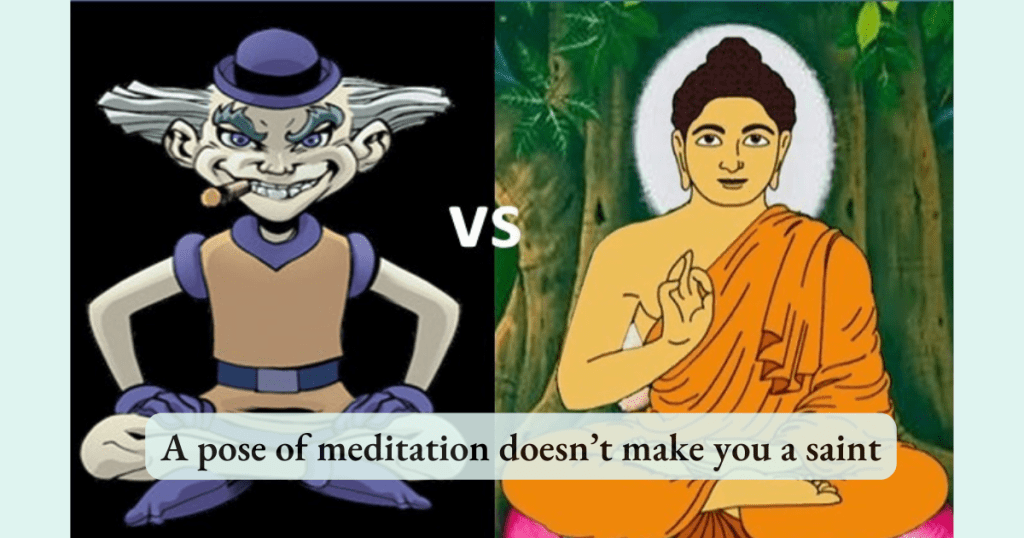
It is obvious Meditation is not the magical potion to convert yourself to goodness. My experience – it is a transformational tool but just that – a tool. And a tool is dependent on the user’s discretion. That is why we should not consider someone a saint just because they practiced Meditation regularly, or read religious books, and performed rituals.
The beauty of Meditation is it calms our mind, increases our concentration, and increases our mental capacity. But I may apply my newfound focus on finding ways to fool people, who knows. It does increase compassion and goodness and make people better humans. But for that to happen there needs to be the seed of goodness somewhere. If a person has been so wrapped up with his anger that he didn’t pay heed to his compassionate self. Meditation will resolve that. As it will get you a grip on your anger and let your inner beauty take over.
Many beautiful miracles sprout from the seed of Meditation when practiced progressively. But these are applicable only to those who have an inner compass pointing towards goodness. Thus, enjoy the supreme beauty of Meditation, but do not lock your common sense within.
Why Do People Fall for Fake Gurus?
It’s simple—because we’re searching. We want peace, clarity, or an escape from stress. And when someone presents themselves as the answer to all our problems, it’s tempting to believe them. But meditation doesn’t work overnight, and no external guru can do the work for you.
What to Look for in a Genuine Meditation Teacher
✔️ They encourage self-awareness – A true teacher helps you understand yourself rather than making you dependent on them.
✔️ They have verifiable experience – Check their credentials, their journey, and whether they have a solid practice backing their claims.
✔️ They don’t demand blind faith – Meditation is about awareness, not submission. If you’re told to follow without question, it’s a red flag.
✔️ They teach simple, accessible practices – Real meditation doesn’t need theatrics. It should be something you can do on your own, without expensive tools or rituals.
I have always believed in the goodness in people and have met trustworthy people. But it helps when I don’t assume beforehand if someone is good or bad, I just let life and my intuition guide me. It hurts me to know when someone gets duped in the name of spirituality. A little common sense can go a long way with all kinds of people.
Final Thoughts: Stay Mindful, Stay Free
Meditation is a transformative tool, but in the wrong hands, it can become a trap. Stay mindful—not just in your practice, but in choosing who you trust on your spiritual path.
Have you ever encountered a questionable meditation teacher? Share your story in the comments below! 👇
I share reflections on personal growth, inner clarity, and navigating change—quietly and thoughtfully. You’re welcome to connect with me on [Instagram] or [Facebook].
Life can feel overwhelming at times—whether it’s work, decisions, or just finding balance. You don’t have to figure it all out alone. If you’d like a space to reflect, gain clarity, or move forward, feel free to explore my coaching page. I’d love to support you on your journey.
Meditation is widely spoken about as a path to calm, clarity, and emotional strength. For many people, it truly is.
My own life changed significantly once I developed a regular meditation practice. It helped me slow down, observe myself more clearly, and feel less controlled by constant mental noise. I continue to value meditation deeply.
And yet, over time, I began noticing something we rarely talk about.
Not everyone’s experience with meditation is gentle or stabilising—especially in the beginning.
Why this conversation about meditation safety matters
Occasionally, media reports surface about people who experienced panic attacks, emotional instability, extreme detachment, or confusion after intensive meditation practices. These stories are often dismissed or quickly buried, partly because they sit uncomfortably beside the overwhelming evidence of meditation’s benefits.
Most research focuses on positive outcomes—and rightly so. But when a practice is powerful, its side effects, even if rare, deserve attention.
Ignoring these experiences doesn’t protect meditation. It leaves certain people unprepared and unsupported.
Despite growing research on meditation’s benefits like the recent Berkeley research cited here, these difficult experiences are often dismissed. They deserve discussion, not silence.
Is meditation harmful or unsafe for some people?
For the vast majority of people, meditation is beneficial.
But a more honest question might be: Is meditation neutral for everyone, at every stage of life, in every mental state?
Even meditation teachers acknowledge that the same practice affects people differently. Some feel calmer. Some more intuitive. Some emotionally lighter. Others experience intense emotional release, fear, or disorientation.
Just as food, exercise, or medication doesn’t affect all bodies the same way, inner practices don’t affect all minds the same way either.
A small minority may experience difficulty—not because meditation is “bad,” but because inner change arrived faster than their ability to integrate it.
Let us come to the point – What can actually go wrong? Hidden challenges and risks of meditation
1. The power of meditation
First of all, meditation is truly powerful. Those who have experienced it know this.
It will not make you enlightened overnight. But it can influence the body and mind in subtle ways. Many spiritual traditions even believe it can open the third eye or lead to unusual experiences like visions. Don’t worry—this is not common. But imagine not knowing any of this, and suddenly experiencing unfamiliar sensations or inner messages. Wouldn’t that be frightening? How would I know whether I am being delusional, or whether something within me has suddenly changed?
If I am alone at night and hear a sound in my head, I might think I am going mad. Even a small, unrelated noise—because of heightened awareness—could be misinterpreted as a message.
2. Suppressed trauma from the past, or underlying mental health vulnerabilities, are not uncommon. The mind suppresses emotions because, at some point, they felt unmanageable. What will happen when the suppressed problems start resurfacing?
When meditation brings them back to the surface, the mind may now be more aware—but the tools to process those emotions may still be missing. What happens then?
3. Meditation also initiates a path of detachment. For centuries, people have left households to follow the path of yogis. Detachment can be deeply helpful—it frees us from greed, temptation, and crowded thinking. But these patterns have also been part of our life for a long time.
Consider a prosperous criminal who suddenly decides to transform. He may genuinely change, but the world around him has not. People remain suspicious. Without his power or money, he may no longer be respected. Can he survive this sudden shift? Such transformations often come with short-term hardship, and without guidance, they can be destabilising.
4. We are also often addicted to relationships. Sometimes we fall in love simply to feel valued or appreciated. What happens to these relationships if we suddenly become emotionally stronger and no longer depend on others for validation? Would some connections dissolve? Could we end up alone—for a while—before building healthier bonds?
5. And then there is society. Someone may leave a high-stress but prestigious job that others admire. Or step away from a marriage that has long been toxic. Society may see this not as growth, but as foolishness. I am not saying society should dictate our choices—but when judgment or ridicule arrives suddenly, support becomes crucial.
These are some of the ways meditation can be transformative. But if such changes are not understood or supported during sensitive phases, they can become deeply unsettling.
So, what is the solution to these meditation risks?
Meditation itself isn’t the problem. Lack of preparation and support is.
Meditation is powerful because it changes how we relate to our thoughts, emotions, and identity. Any practice that works at this depth needs the same care we would give to physical or emotional healing. The risks don’t come from meditation alone, but from entering deep inner change without context, guidance, or grounding.
Some safeguards matter more than others.
1. Start gently, not intensely
Not every mind needs silence, long hours, or forceful techniques right away. Gentle practices help the nervous system settle before awareness deepens. In fact, many experienced meditation teachers begin with safer techniques and move to advanced practices only after stability develops.
When intensity comes too early, awareness can expand faster than emotional stability. Slower beginnings allow the mind to adapt, rather than react.
Progress in inner work is not about speed. It is about stability.
2. Balance awareness with emotional grounding
Meditation increases awareness—but awareness alone does not automatically bring resolution.
As buried emotions, memories, or fears surface, people also need ways to process them. Grounding practices, reflection, journaling, body awareness, or simple conversations help translate inner insight into emotional understanding.
Without grounding, awareness can feel overwhelming. With grounding, it becomes meaningful.
3. Seek guidance when change feels confusing
Guidance does not mean dependence. It means orientation.
A trusted meditation teacher, spiritual mentor, therapist, or counselor can help distinguish between:
temporary discomfort and deeper distress
healthy detachment and emotional withdrawal
inner growth and psychological overload
This kind of guidance helps people stay connected to reality while inner perspectives shift.
4. Choose community over isolation
Meditation is often practised alone—but transformation should not be.
Community provides normalization. When people hear others speak honestly about confusion, fear, or disorientation, they stop assuming something is “wrong” with them.
Some institutions offer weekly or monthly group meetings for this reason. These spaces don’t need to be profound. They just need to be human and real.
Isolation amplifies fear. Shared experience softens it.
5. Talk openly about difficult experiences
The silence around meditation difficulties does more harm than the difficulties themselves.
When negative or unsettling experiences are hidden or dismissed, people internalize shame. When they are spoken about openly, they become understandable—and manageable.
Open discussion leads to better teaching, safer practices, and more research. Avoiding the topic delays progress for everyone.
6. Involve medical or psychological support when needed
Meditation is not a replacement for medical or psychological care.
If someone experiences intense anxiety, panic, dissociation, or physical symptoms, spiritual insight alone may not be enough. In such cases, professional help provides grounding and safety.
There is no conflict between inner work and medical support. Both serve the same purpose: well-being.
7. Stay connected to everyday life
Even when meditation is practised privately, everyday support matters.
Friends and family don’t need to understand meditation deeply. They just need to be present—people who can notice changes, offer reassurance, or step in when someone feels overwhelmed.
Inner growth does not require disappearing from life. It requires staying connected while changing.
A responsibility meditation spaces cannot ignore
Ideally, meditation centres should offer more than techniques. They should offer integration support.
Separate counselling or guidance spaces for those struggling during meditation would prevent unnecessary suffering. Clear guidelines for safe practice, gradual progression, and emotional readiness would benefit not just meditators—but society as a whole.
In a world where many people are already carrying unprocessed emotional weight, support is not optional. It is essential.
A quiet reminder
Meditation asks for openness, but not the suspension of judgment. Discernment and practicality are part of any genuine path.
If meditation has ever left you feeling confused, detached, anxious, or overwhelmed, you haven’t failed—and you’re not broken.
Sometimes, growth simply needs containment.
And sometimes, clarity comes not from more practice, but from reflection, conversation, and support.
I share reflections on personal growth, inner clarity, and navigating change—quietly and thoughtfully. You’re welcome to connect with me on [Instagram] or [Facebook].
Feeling Stuck? Let’s Figure It Out Together.
Life can feel overwhelming at times—whether it’s work, decisions, or just finding balance. You don’t have to figure it all out alone. If you’d like a space to reflect, gain clarity, or move forward, feel free to explore my coaching page. I’d love to support you on your journey.