How did humiliation become normal?
Public humiliation is becoming normal — and it’s costing us our dignity.
From a Miss Universe contestant being insulted on stage to an actor body-shamed during an interview, and employees being scolded at work — disrespect has seeped into our culture.
Most of us would call that rude.
But the truth is — we’ve normalized it.
We see it on world stages, in press conferences, and in our workplaces.
But these incidents turned out to be different. In these, the perpetrator was called out in front of everyone.
In this article, we’ll explore why calling out humiliation isn’t aggression but the first step toward authentic leadership and dignity at work.
When Miss Universe 2025 contestants, walking out showed their courage
At the Miss Universe 2025 event in Thailand, a shocking moment unfolded.
The national director publicly berated Miss Mexico, Fátima Bosch — calling her a “dummy” and ordering security to escort her out.
For a moment, the room fell silent.
Then, several contestants stood up and walked out in solidarity.
That single act — calling it out — turned humiliation into resistance.
It reminded the world that no title, no position, gives anyone the right to strip someone else of dignity.
Gouri Kishan’s Stand Against Body Shaming
When Gouri Kishan refused to accept an irrelevant question about her weight at a press meet, she asked the key question: “Would you ask a male actor the same?”
That one question flipped the power dynamic.
It exposed a bias that we’ve all grown used to — that it’s okay to comment, to “tease,” to humiliate under the guise of curiosity.
What she did was not just about gender — it was about calling out the normalization of disrespect.
These headlines may seem extreme, but humiliation at work and toxic workplace culture often start small — a sarcastic remark here, a public rebuke there.
It Happens Everywhere — Even at Work
Workplace Humiliation: The Hidden Epidemic
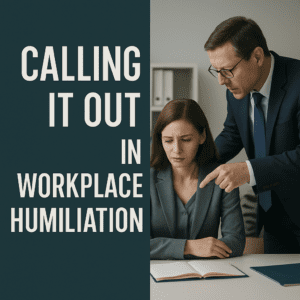
These incidents made headlines, but they echo what many experience in quieter ways.
A team member being scolded publicly in a meeting.
A manager using sarcasm instead of feedback.
A colleague mocking someone’s mistake to look “confident.”
Research on workplace culture shows that humiliation is one of the most corrosive experiences an employee can face.
It doesn’t just hurt morale — it rewires the culture to make disrespect seem “normal.”
Humiliation is not a leadership tool.
It’s a power play that erodes trust, creativity, and authentic connection.
The Common Thread of disrespect and humiliation at work and life irrespective of gender
What links these stories — from global stages to office rooms — is not gender or profession.
It’s power and silence.
Someone in a position of authority crosses a line.
Others look away.
And the act becomes “acceptable.”
Every time we stay silent, we reinforce that behavior.
But every time we speak up — even gently — we reclaim dignity.
🌿 How to Call Out Disrespect Without Confrontation
Learning how to speak up against humiliation doesn’t mean aggression — it means boundary-setting and authenticity.
Here’s how we begin:
- Notice it.
Catch the subtle moments — the jokes, remarks, or tones that degrade. - Pause the silence.
A simple acknowledgment can shift the moment:
“Hey, that didn’t sound fair.”
- Set boundaries respectfully.
“I prefer we keep this conversation professional.”
- Model dignity.
Lead by example — your tone, your words, your empathy. - Support others.
When someone else is humiliated, stand with them.
That moment of solidarity might be what restores their self-worth.
The Butterfly Effect of Dignity
When we call out humiliation, we don’t just defend ourselves — we reshape culture.
Fátima Bosch’s walkout, Gouri Kishan’s calm defiance, or an employee choosing to speak up in a meeting — all these moments ripple outward.
They remind us that respect isn’t granted by position; it’s earned by behavior.
Dignity is not a privilege.
It’s the foundation of humanity — and the first step toward authenticity.
💭 A Question for You to Claim our Dignity
The next time you witness a moment of humiliation — big or small — ask yourself:
Will I stay silent?
Or will I call it out, kindly but firmly?
Because every act of silence strengthens the abuser.
And every act of courage restores humanity.
Reclaiming respect at work and living with dignity begins when we call out humiliation instead of tolerating it.
Don’t forget to check my article on How to gain confidence at work, and manage these situations easily

Feeling Stuck? Let’s Figure It Out Together.
Life can feel overwhelming at times—whether it’s work, decisions, or just finding balance. You don’t have to figure it all out alone. If you’d like a space to reflect, gain clarity, or move forward, feel free to explore my coaching page. I’d love to support you on your journey.